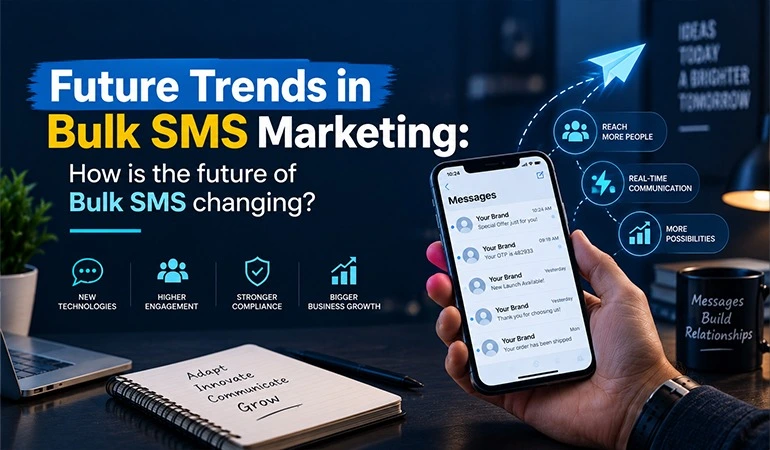
Bulk SMS marketing has long been an effective way for businesses to reach customers quickly and directly. But now, bulk SMS is no longer limited to sending the same message to thousands of people.
Technologies like AI, customer data, automation, RCS and conversational messaging are taking SMS marketing to a new level. In the future, businesses will focus on more relevant, personalized and timely communication.
This shift is also important for messaging platforms like NationalBulkSMS, as businesses now seek not just message delivery, but better customer engagement and measurable results.
1. AI-Powered SMS Personalization Will Increase
In the future, sending the same message to every customer may be less effective. AI will help make communication more relevant by understanding customer behavior, previous purchases, location and engagement patterns.
For example, instead of sending the same discount SMS to all customers, an online store could send offers to different customers based on their previous shopping.
With the help of AI, businesses can also understand what type of message would be best to send to each customer and at what time.
Future personalization could include:
- Messages based on customer name and preferences
- Offers based on previous purchases
- Location-based promotions
- Behavior-based campaigns
- Follow-up messages based on customer engagement
2. RCS will make SMS marketing more interactive
RCS or Rich Communication Services, offers a more interactive messaging experience than traditional SMS. Features like images, videos, buttons, rich cards, carousels and branded business profiles can be available.
This means that in the future, customers could have a better experience of viewing a product, understanding an offer or taking action within the message itself, rather than just sending text and a link.
According to Google, RCS for Business offers features like verified business identity, rich media, suggested actions and analytics.
So, instead of considering Bulk SMS and RCS as separate channels, businesses can use them as separate parts of their communication strategy.
3. Smart Combination of SMS and RCS
Despite the rise of RCS, the role of traditional SMS will not disappear. RCS is not required on every customer's device or network. In such cases, SMS can serve as a fallback communication. Google's RCS documentation also mentions falling back to another communication channel, such as SMS, for unsupported devices.
So, a future messaging strategy could look something like this:
- Rich interactive messaging where RCS is available
- Traditional SMS where RCS is not available
- SMS for important alerts
- RCS for product discovery and engagement
This approach can help businesses balance both customer reach and messaging experience.
4. The Expansion of Conversational SMS Marketing
In the past, SMS marketing was mostly a one-way communication. The company sent the message and the customer read it.
Now, businesses are moving toward messaging experiences where customers can engage in further conversation in response to the message.
For example, a customer receives an appointment reminder SMS. The message may include a confirmation or rescheduling option. After the customer responds, an automated system can initiate the next step.
RCS for Business also supports features like user-initiated conversations and suggested actions.
This could transform SMS from a simple notification channel to a customer interaction channel.
5. Omnichannel Messaging Will Become More Important
In the future, businesses will no longer rely solely on SMS. SMS, RCS, WhatsApp, email, app notifications and other channels will be used to tailor the customer journey.
For example:
- Detailed information from email
- Important reminder from SMS
- Customer conversation from WhatsApp
- Interactive product experience from RCS
- Final confirmation from SMS
This way, customers can have a connected experience across multiple channels.
Messaging solutions like NationalBulkSMS offer businesses a way to incorporate SMS into a broader messaging strategy based on their communication goals.
6. Automation will simplify campaign management
In the future, there will be less need to manually manage bulk SMS campaigns.
Businesses will be able to create automated workflows that automatically trigger the next message based on customer activity.
For example:
- New customer registration → Welcome SMS
- Product purchase → Confirmation SMS
- Order dispatch → Delivery update
- Cart activity → Reminder
- Payment due → Payment reminder
- Inactive customer → Re-engagement message
This way, communication will no longer be solely campaign-based; it will become integrated with the customer journey.
7. Better Analytics and Real-Time Tracking
In future SMS marketing, simply knowing how many messages were sent will no longer be enough.
Businesses will look more closely at metrics like delivery, clicks, responses, conversions and customer actions.
RCS for Business offers capabilities like read receipts and analytics, allowing businesses to understand messaging performance in greater detail.
Analytics can help businesses determine which messages are working and which campaigns need changes.
8. Greater Focus on Data Privacy and Trust
As messaging grows, customer trust will also be crucial. Businesses will need to make responsible use of customer data and keep communications relevant.
Verified business profiles and verification features in RCS can help customers identify which business a message is from.
Google has also emphasized branding, verification and anti-spam measures for RCS for Business.
Therefore, both quality communication and responsible messaging will be important in future SMS marketing.
9. Two-Way Communication Can Improve Lead Generation
The use of SMS in lead generation will not be limited to sending inquiry links.
Businesses can send messages to interested customers and receive immediate responses.
For example, an education company might run a campaign:
“Want information about a Digital Marketing Course? Press 1.”
Further communication can be automated based on the customer's response.
This approach can provide easier interaction for the customer rather than requiring them to fill out a lengthy form.
Use Case 1: E-commerce Business
Suppose a fashion brand wants to promote a new collection to its existing customers.
In a traditional approach, a uniform promotional SMS could be sent to all customers.
In a future-focused approach, different segments could be created based on customer data. Regular buyers could be sent messages about new arrivals, inactive customers special reactivation offers and recent buyers could be sent messages about complementary products.
Where RCS is available, product images and interactive buttons can also be used.
Use Case 2: Healthcare Appointment Reminders
Messaging for healthcare businesses isn't limited to marketing.
A clinic could send a confirmation SMS after an appointment booking. A reminder can be sent before the appointment and the customer can be given the option of confirmation or rescheduling.
In this way, messaging can become a part of both customer service and operational communication.
Case Study 1: Personalized Campaign of a Retail Brand
This is an illustrative case study.
Suppose a retail brand divided its customer database into three segments based on purchase behavior.
Initially, a generic promotional SMS was sent to all customers. Later, the brand tailored different messages for different customer groups.
Frequent customers received an early-access offer, inactive customers received a reactivation discount and recent buyers received recommendations for related products.
This change made the campaign more relevant and allowed the marketing team to understand how different customer segments responded to communication.
Case Study 2: Automated Follow-Up in the Education Business
This is also an illustrative case study.
Suppose a training institute receives a steady influx of inquiries from its website and advertising campaigns.
Previously, the sales team manually followed up on each inquiry. Later, the institute adopted an automated SMS workflow.
An acknowledgement SMS was sent immediately after a new inquiry. This was followed by course details, counseling reminders and follow-up communications based on customer response.
This reduced the sales team's time spent on repetitive communication and ensured interested leads received timely information.
Future-Ready SMS Marketing for NationalBulkSMS
Successful SMS marketing in the future will not rely solely on large contact lists and high-volume messaging.
Businesses must focus on the right customer, the right message, the right time and the right communication channel.
Through NationalBulkSMS, businesses can integrate Bulk SMS into their communication strategy for various purposes such as promotional campaigns, transactional communication, alerts, reminders and customer engagement.
The messaging ecosystem is constantly evolving with developments like RCS, automation, personalization and analytics. Reports indicate growth in RCS interactions in India by 2026 and a shift towards conversational engagement.
FAQs
No. The role of SMS is changing. With RCS and other messaging channels, SMS will continue to be used as an important communication and fallback channel. Its utility may remain, especially for alerts, reminders, OTPs and time-sensitive communication.
AI can help with personalization, segmentation and timing based on customer behavior and engagement data. This can help businesses create more relevant messages and reduce unnecessary communication.
Traditional SMS primarily offers text-based messaging. RCS can offer features like rich media, branded business identity, buttons, carousels and interactive experiences. SMS fallback can also be useful when RCS is not available.
Yes. Small businesses can initially start with features like customer segmentation, automated reminders and personalized messages. RCS, CRM integration and advanced automation can be added later as needed.
The primary focus should be on message relevance, timing and customer consent. Personalization, automation, analytics and the right channel selection can then help make the campaign more useful.


