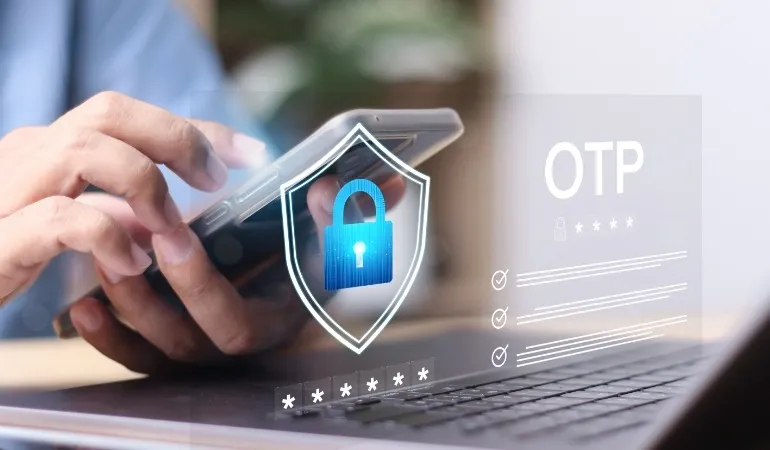
In today's computerized world, mainly everything is done online. Managing an account, shopping, social media, government administrations and indeed school or office portals depend on the web. As online services have expanded, so has the concern for security. In this setting, the One-Time Password (OTP) has developed as a dependable security measure.
What is an OTP?
OTP means One-Time Password. As the title proposes, it is a password that can be utilized as it were once. Not at all like normal passwords, it cannot be utilized repeatedly.
Whenever you log in to a site or app, make a payment, or verify your identity, the framework sends a temporary code to your enlisted portable number or mail. This code is called an OTP.
An OTP is ordinarily substantial for as if it were a few seconds or minutes. After the time constraint expires, it consequently gets to be invalid.
Why was OTP needed?
Previously, logging in was done as it were with a username and password. But over time, occurrences of hacking, phishing and information theft increased. Many individuals utilized the same password in diverse places, which advanced the risk.
OTP gave a viable arrangement to this issue. Indeed if somebody knows your password, they cannot log in or total an exchange without the OTP. In this way, OTP includes an additional layer of security.
How does OTP work?
Understanding the OTP process is simple:
- You attempt to log in or make a payment on an app or website.
- The system identifies your mobile number or email.
- A unique code is generated.
- This code is sent to you via SMS, email or through an app.
- You enter the code within the specified time limit.
The process proceeds only after the correct OTP is entered. This entire process is completed in just a few seconds, but it is quite effective in terms of security.
What is the Type of OTP?
OTPs can be sent and used in different ways.
SMS based OTP: This is the most common method. The OTP arrives directly as a message on your mobile number. It is most widely used in banking and online payments.
Email based OTP: Some platforms send the OTP via email. This method is useful when a mobile network is not available.
App based OTP: A few apps, such as authenticator apps, create OTPs periodically. This does not require web or network connectivity; the app essentially needs to be set up beforehand.
Hardware token OTP: In large organizations or high-security systems, a small device is provided that generates the OTP. This method is less common for general users.
What is the Advantage of OTP?
OTP has several practical benefits.
- It gives an additional layer of security to the account.
- Having an unused password each time decreases the risk of hacking.
- It is simple to utilize and does not require technical knowledge.
- It increases trust in banking and financial transactions.
- Identity verification is done quickly and securely.
- This is why almost every digital service uses OTP today.
Limitations of OTP
- In spite of the fact that OTP is considered very secure, it moreover has a few limitations.
- If the mobile phone is lost, getting the OTP can be difficult.
- In locales with frail network coverage, SMS OTPs may be delayed.
- People can commit extortion by inquiring for OTPs through phishing calls or messages.
- If the client is not careful, the OTP can fall into the wrong hands.
- Therefore, awareness is just as imperative as utilizing OTPs.
Important Safeguards Related to OTP
- If the mobile phone is lost, getting the OTP can be difficult.
- In locales with frail network coverage, SMS OTPs may be delayed.
- No bank or company worker will ever inquire about your OTP.
- Do not share your OTP on unknown links or calls.
- If you get an OTP without any reason, be promptly vigilant.
- Keep your mobile and e-mail secure.
By taking after these basic safety measures, you can avoid significant losses. OTP and Two-Factor Authentication.
OTP is a regular portion of two-factor verification. This implies your identity is confirmed in two ways: to begin with, your password, and second, the OTP.
This strategy has gotten to be a standard for online security nowadays, and its part is expected to develop further in the future.
FAQs
Regularly, an OTP is substantial for 30 seconds to 5 minutes. It consequently expires after the time limit.
Check your network connection, hold up a while, or utilize the "Resend OTP" alternative. If the issue continues, contact client support.
OTPs are very secure, but as it were if you do not share them with anybody and are attentive to phishing attempts.
Yes, a few services moreover give OTPs by means of email or an authenticator app.


